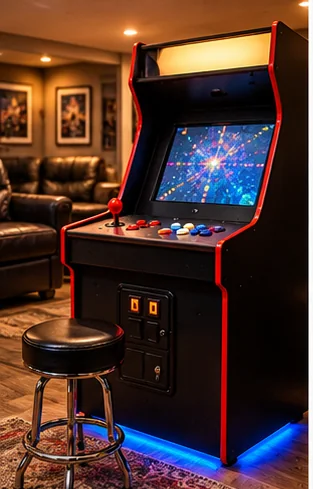
Products and configurations to compare
Legends Ultimate CE-HD
The current CE-HD is 79.55 lb and includes 300 built-in games with connected services and purchasable content.
Best when: you want one flexible full-size home arcade platform
Watch for: software/account features require more learning than a simple fixed cabinet
Legends Core Max HD
The Core Max is a small hardware platform rather than a cabinet and can be useful for a couch or DIY-control-panel build.
Best when: you like the AtGames ecosystem but do not need a standing cabinet
Watch for: you must supply display and controls, so the arcade feel depends on your setup
Arcade control panel / accessory ecosystem
AtGames maintains an accessory ecosystem around the Legends family, which is a major part of the platform's value.
Best when: you want to reuse AtGames accessories across compatible Legends hardware
Watch for: compatibility must be checked by exact hardware generation
The 24-inch screen changes the feel
A 24-inch display is materially larger than the 17-inch class found in many consumer dedicated cabinets. Because the control panel is also wide, the proportions read more like a full-size home platform.
The control deck is the reason to buy it
Trackball and spinners add entire game categories that a standard two-stick multicade can only approximate. This is where the CE-HD earns its footprint.
The built-in library is broad, but verify your favorites
AtGames lists 300 built-in arcade and console games. Read the actual game list before purchase rather than assuming a famous title must be present.
Connected features add both value and dependency
Wi-Fi/Ethernet enables updates, leaderboards and content. If you prefer a cabinet that never asks for an account or firmware workflow, a simpler dedicated machine may be more satisfying.
Physical dimensions are house-friendly but not tiny
At roughly 66.4 inches tall and 29.5 inches wide, the machine is much easier to route through a residence than many commercial cabinets, but it still deserves doorway and stair measurements.
Cabinet art is not the same as control compatibility
The fastest way to buy the wrong home arcade is to shop by logo first. Pac-Man wants a clean four-way joystick experience. Street Fighter wants six action buttons and a comfortable two-player panel. Centipede depends on a good trackball. Driving games need wheel and pedal geometry. The cabinet that looks best in the room may be the one you play least if its controls do not match the games you actually care about.
Game count is equally slippery. Three games you love can be worth more than 300 games you scroll past. Treat the game list as a collection, not a spec-sheet score. A dedicated licensed cabinet is strongest when the physical controls and art reinforce a small set of games; a multicade is strongest when breadth and convenience matter more than one iconic presentation.
Home-scale and commercial-scale machines solve different problems
Consumer cabinets are lighter, easier to move through houses and much cheaper to power and service. Commercial machines are deeper, heavier and often more durable, but freight, stairs, doorways and replacement parts become real ownership issues. The right home arcade often mixes one or two special full-size machines with lighter consumer cabinets rather than trying to recreate an operator warehouse.
Before checkout
- Measure final cabinet footprint and player standing space
- Measure the entire delivery route before ordering
- Confirm game list, control layout and number of players
- Check screen size and viewing angle from normal stance/seating
- Confirm Wi-Fi/Ethernet needs and whether online features are optional
- Price stools, risers, mats and surge protection with the machine
- Check warranty, freight damage and return terms
- Confirm replacement controls or parts are realistically obtainable
- Plan ventilation and service access
- Use only game/software content you have the rights to run
Installed cost: the part listings do not show
Budget freight or local pickup, stools or seating, floor protection, surge protection, network access, extension of an existing wired network where appropriate, and an initial parts reserve. If a machine requires permanent electrical work, treat that as room infrastructure rather than hiding it inside the cabinet price. A collection that arrives under budget but has no comfortable place to stand or sit is not actually under budget.
Measure the route with packaging in mind when a machine ships assembled or partly assembled. Door width is only one constraint; stair turns, ceiling height, railings, elevators and the ability to rotate a long cabinet matter. HomeArcadeGuide's doorway and shipping planners exist to catch those mistakes before freight arrives.
How to evaluate the purchase in the first week
Play the games and controls you bought it for, not only the easiest title on the menu. Test every direction/button, both players, audio at quiet and loud levels, network reconnect after power-off, display uniformity and cabinet wobble. If it is a virtual or software-driven platform, update only after confirming the current machine works and documenting its starting state.
Keep the carton and packing material until the return window and freight-damage inspection are safely behind you. Large arcade products are unusually expensive to return, and original packaging can matter if a display or control panel needs to travel for service.
Frequently asked questions
How many games are built into the CE-HD?
AtGames currently lists 300 built-in games.
What size is the screen?
A 24-inch HD LCD.
Does it have a trackball?
Yes, along with high-precision spinners and arcade joysticks.
How much storage does it have?
AtGames currently lists 16GB internal storage, with 7GB available to the user.
Primary/current sources
Affiliate disclosure: HomeArcadeGuide.com may earn from qualifying purchases through Amazon Associates and eBay Partner Network at no extra cost to you. Manufacturer links in the source section are research references, not tracked endorsements.